Patent Title:
Apparatus for testing sterilization methods and materials
Assignee:
Inventors:
Ross Caputo, Robert Reich, Robert Thrash, Jimmy Fisher, Davoud Khorzad, Thomas Cullen
Patent:
Summary Related to Ultrasonic Nozzle used for Sterilization Testing:
Apparatus and method for testing one or more sterilization indicators (e.g., biological indicators or chemical indicators) or other articles by contacting them under controlled sterilization conditions with a flowing antimicrobial gas containing hydrogen peroxide vapor are disclosed. This invention also provides apparatus and method for testing sterilization processes that use a flowing antimicrobial gas containing hydrogen peroxide vapor under controlled sterilization conditions, or for testing materials for such processes under controlled sterilization conditions, or for testing both such processes and such materials under controlled sterilization conditions. There can be an essentially square-wave contact of the sterilization indicators or other articles with the antimicrobial gas (i.e., short rise time to reach full concentration of the antimicrobial gas in contact with the sterilization indicators or other articles and short fall time to remove all of the antimicrobial gas from contact with the sterilization indicators or other articles). A preferred way of generating a substantially constant flow of antimicrobial gas of substantially constant hydrogen peroxide concentration may be used to generate the antimicrobial gas. A preferred way of determining the hydrogen peroxide concentration in the antimicrobial gas may be used.
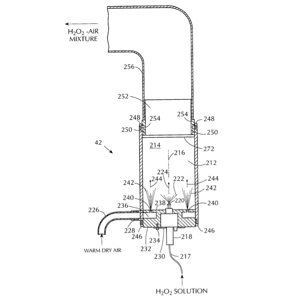
Breaking the vaporizable liquid into fine particles can be accomplished in any way that provides particles that are small enough and that flow inside the vaporization plenum in the desired direction. Devices such as atomizers or ultrasonic devices may be used. For a 30% w/w aqueous solution of hydrogen peroxide, an ultrasonic device has been found to be satisfactory as part of the apparatus seen below.
A cylindrical 6061 non-anodized aluminum pipe with a wall thickness of about 0.25 inches (about 6.4 millimeters) was used for the vaporization plenum. Stainless steel (e.g., type 316) could also have been used. Whatever the material of construction, it desirably is machinable as well as being sufficiently inert to the fluids to be processed in it. The inner diameter of the pipe was approximately 4.5 inches (approximately 114 millimeters) and the length of the vaporization plenum (from inner surface of cylindrical end block 232) to the beginning of nipple was approximately 7 inches (178 millimeters) long. Cylindrical end block was approximately 1.45 inches thick (37 millimeters). Toroidal plenum had an inner diameter of approximately 2.25 inches (57 millimeters), was approximately 0.5 inches (12.7 millimeters) high, and its upper surface lay approximately 0.2 inches (5 millimeters) below inner surface. An electrical heating tape was wrapped around the outside of vaporization plenum and sufficient heat was supplied to keep the temperature of the vaporization plenum wall above 30° C. (ambient temperature was approximately 22° C.). Conduit was left uninsulated to allow heat to leave the system so that the temperature of the gas-phase flow of air and vaporized hydrogen peroxide aqueous solution would fall.